
Buying a House in Turkey: What UK Buyers Need to Know in 2026
İçerikler
Most of what goes wrong when British buyers purchase a house in Turkey isn’t a legal trap or a scam — it’s a small assumption carried over from how property works in the UK that simply doesn’t apply. Here are the ten things that catch UK buyers out most often in 2026, and what to do about each one before you’re standing in front of a Land Registry official.
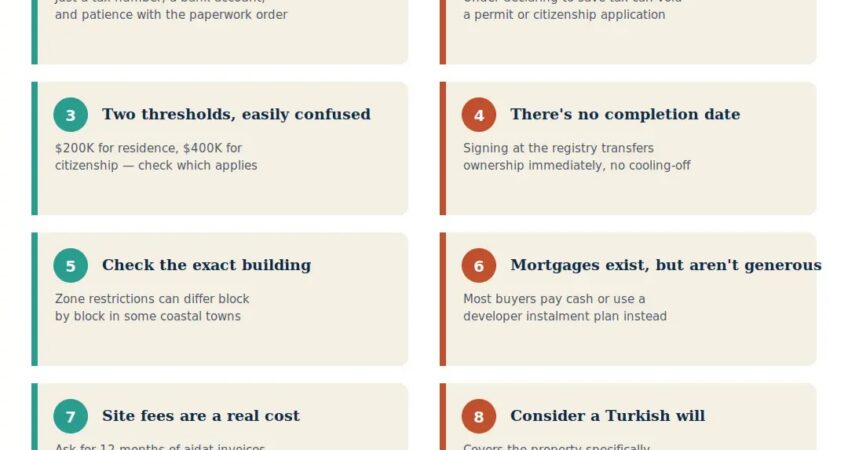
1. You don’t need residency to buy — but you do need patience with paperwork
A valid passport is enough to start. What takes time is the sequence behind it: a Turkish tax number, a local bank account, and the Foreign Exchange Purchase Certificate (DAB) your funds generate when they move through it. None of this is difficult, but it has to happen in order, and skipping ahead usually just means doubling back later.
2. The declared price has to match the valuation — exactly
Every foreign purchase requires a licensed (SPK) appraisal, and the figure on your title deed must match it. Agreeing an “official” lower price with the seller to reduce the 4% purchase tax isn’t a grey area — it’s tax evasion, and since 2026 it’s been grounds to unwind a residence or citizenship application after the fact.
3. There are two different thresholds, and they’re easy to mix up
$200,000 qualifies a single property for a residence permit. $400,000 opens the route to citizenship, with a compulsory three-year resale restriction attached to the deed. Buyers occasionally assume the lower figure covers both — it doesn’t, and the two applications follow entirely different processes.
4. There’s no completion date — signing is owning
UK transactions have a gap between exchange and completion that gives everyone a moment to double-check things. Turkey doesn’t: signature at the Land Registry transfers ownership immediately. That makes due diligence something that has to happen entirely before you sign, not something you can leave loose ends on and tidy up afterward.
5. Zone restrictions can vary building by building
A property being outside a military or security zone isn’t something you can assume because the block next door cleared fine. This check needs running on the specific property, and it’s worth confirming independently rather than taking an agent’s word for it.
6. Mortgages exist, but they’re not generous
Turkish banks do lend to foreign buyers, but at higher rates, shorter terms, and lower loan-to-value than UK buyers are used to — often capped around 50%. Most British buyers either pay cash, remortgage a UK property, or use a developer’s own instalment plan for off-plan purchases.
7. Site fees (aidat) are a real, recurring cost
Apartments in managed developments carry mandatory service charges that aren’t always volunteered clearly in the listing. Ask for the last twelve months of aidat invoices before you commit — it’s the easiest way to find out what a “cheap” apartment actually costs to hold.
8. A Turkish will is worth having alongside your UK one
Turkish property is generally subject to Turkish inheritance law regardless of what your UK will states for the rest of your estate. A short Turkish will covering just the property removes the ambiguity of two legal systems potentially disagreeing about who inherits it.
9. Your UK tax obligations don’t disappear
Buying abroad doesn’t buy you out of HMRC. Rental income generally still needs reporting, Capital Gains Tax can apply on sale, and the property typically forms part of your estate for UK Inheritance Tax. A double taxation treaty between the UK and Turkey should stop the same income being taxed twice — but that’s a reason to speak to an accountant beforehand, not a reason to assume it sorts itself out.
10. Build in a margin, especially near a threshold
If your purchase is meant to clear $200,000 or $400,000, don’t price it exactly there. Currency movement between exchanging pounds and completing the purchase, or a valuation that comes in fractionally different from the agreed price, can be enough to drop a borderline purchase below the line you needed it above.
Bottom line
None of these ten points make buying a house in Turkey harder than it should be — they just describe a system that runs on different defaults than the one UK buyers are used to. Once you know where those defaults differ, the process itself is genuinely fast: weeks, not months, for a straightforward cash purchase.
This guide reflects rules understood to be in force in 2026. Requirements have changed more than once in recent years — confirm current thresholds and rules with a licensed Turkish solicitor before transferring any funds.
