
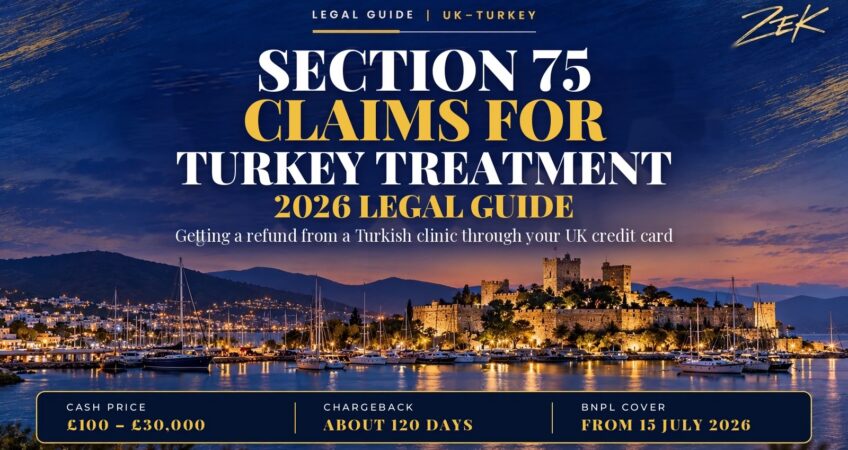
Section 75 Claims for Treatment in Turkey: A 2026 Guide for UK Patients
İçerikler
Thousands of UK residents travel to Turkey every year for dental work, hair transplants and cosmetic surgery. Most come home happy, but when a clinic cancels a procedure, swaps the surgeon, leaves out the aftercare it promised or simply stops answering messages, getting money back from a business in Istanbul or Antalya can feel impossible. This is where a Section 75 claim can help. If you paid with a UK credit card (or, since July 2026, with a regulated buy now, pay later plan), your card provider may be legally responsible alongside the Turkish clinic.
This 2026 guide explains when a Section 75 claim covers treatment in Turkey, how it differs from a chargeback, why paying through a broker can quietly remove your protection, and how to build a claim that your bank and the Financial Ombudsman will take seriously.
What Is a Section 75 Claim?
Section 75 of the Consumer Credit Act 1974 makes a credit provider jointly and severally liable with the supplier when the supplier breaks the contract or misrepresents what you are buying. In practical terms, if a Turkish clinic you paid by credit card fails to deliver what it agreed, you can bring the same claim against your UK card issuer that you could bring against the clinic itself. You do not have to sue the clinic in Turkey first.
A Section 75 claim is not limited to purchases made inside the UK. In Office of Fair Trading v Lloyds TSB Bank plc [2007] UKHL 48 the House of Lords confirmed that the protection extends to transactions made abroad, which is why it matters so much for medical tourism.
Breach of contract and misrepresentation
There are two legal routes. Breach of contract covers situations where the clinic did not provide what was agreed, or did not provide it with reasonable care and skill. Misrepresentation covers false statements that persuaded you to book, such as claims about the surgeon’s qualifications, the materials used or what the package included. Your bank will also consider consumer law that implies terms into the contract, including the Consumer Rights Act 2015 where it applies.
When a Section 75 Claim Covers Treatment in Turkey
A Section 75 claim is only available if several technical conditions are met. Banks check these first, so it pays to check them yourself before you write.
| Condition | What it means for Turkish treatment |
|---|---|
| Cash price over £100 and not more than £30,000 | The limits apply to the price of the single item or service (for example, the treatment package), not to what you put on the card. |
| Paid at least partly on credit | A deposit paid by credit card can be enough, even if you paid the balance in cash at the clinic. |
| Direct link between you, the lender and the clinic | The card payment must reach the supplier you contracted with, not an unrelated middleman. |
| Breach or misrepresentation by the supplier | You must show that something was promised and not delivered, or that you were misled. |
The £100 to £30,000 cash price rule
Most Turkish dental, hair and cosmetic packages fall comfortably inside the range for a Section 75 claim. What matters is the cash price of the treatment, so a £4,500 veneer package is covered even if only the £500 deposit went on your credit card. Very expensive multi-procedure surgery may exceed £30,000, in which case a lender can sometimes still be liable under Section 75A if you used a linked point-of-sale loan.
Buy now, pay later since 15 July 2026
Deferred payment credit (the interest-free buy now, pay later plans offered at checkout) came under Financial Conduct Authority regulation on 15 July 2026. Agreements taken out on or after that date bring Section 75 protection and access to the Financial Ombudsman. Plans taken out before that date remain outside the new rules, so a Section 75 claim will not be available for older BNPL purchases.
Payments that are not covered
- Debit card payments (chargeback may still help).
- Bank transfers, cash, and money sent through transfer apps.
- Cash withdrawn on a credit card and then handed to the clinic.
- Payments funded by an overdraft or a general personal loan.
The Broker and Payment-Processor Trap
The most common reason a Section 75 claim for Turkish treatment fails has nothing to do with the treatment. It is the payment chain. The law requires a “debtor-creditor-supplier” link: you (the debtor), your card provider (the creditor) and the business that contracted to treat you (the supplier). Medical tourism is full of middlemen, and each one can break that chain.
When assessing a Section 75 claim, banks and the Ombudsman look closely at who actually received the money and who you contracted with. Keeping the invoice, the contract and the card statement together makes this much easier to prove.
Chargeback vs a Section 75 Claim
A chargeback is a card-scheme process run by Visa, Mastercard or American Express. It is not a legal right, but banks are expected to use it where there are valid grounds. A Section 75 claim is a statutory right against the lender. Your bank can, and often should, consider a chargeback and a Section 75 claim at the same time.
| Feature | Chargeback | Section 75 claim |
|---|---|---|
| Legal basis | Card-scheme rules | Consumer Credit Act 1974 |
| Cards covered | Debit, credit and charge cards | Credit cards, point-of-sale loans, regulated BNPL from 15 July 2026 |
| Value limits | None | Cash price over £100 and up to £30,000 |
| Time limit | Usually around 120 days from the expected service date or when the problem arose | Follows ordinary limitation rules for the underlying claim, so much longer in most cases |
| What you can recover | Only the amount paid on the card | Can include the full contract price and other losses flowing from the breach |
Because chargeback deadlines are short, contact your card provider as soon as a problem appears. Do not wait for months of correspondence with the clinic to run out first.
What Counts as Breach or Misrepresentation in Medical Tourism
A Section 75 claim succeeds on evidence, not on disappointment. Results that fall short of your hopes are not automatically a breach. These are the situations that most often give rise to a valid claim:
One point that surprises many patients: the value of the claim is usually assessed under the law that governs the contract, which for services delivered in Turkey may be Turkish law. A clear written contract and invoice therefore matter as much as the medical evidence. For treatment-specific advice, see our guides on Turkey teeth and your legal rights and hair transplants in Turkey that go wrong.
Is your clinic in Turkey refusing a refund?
ZEK Legal UK reviews your contract, Turkish-language correspondence and payment records, and helps you prepare a well-evidenced Section 75 claim or chargeback request. Where action is needed in Turkey, we work with lawyers registered with the Ankara Bar.
WhatsApp +44 7748 245895 Email zeki@zeklegal.co.ukHow to Make a Section 75 Claim Step by Step
- Collect your paperwork. Contract, quotes, treatment plan, invoices, receipts, card statements, WhatsApp and email messages, marketing screenshots and before-and-after photos.
- Complain to the clinic in writing. State clearly what went wrong and what you want (refund, corrective treatment or compensation). Give a reasonable deadline. Keep a copy of any reply, translated if it is in Turkish.
- Get independent evidence. For quality complaints, a report from a UK dentist, surgeon or trichologist explaining what was done and why it falls short is often decisive.
- Write to your card provider. Say you are making a Section 75 claim under the Consumer Credit Act 1974 and ask them to raise a chargeback as well. Attach your evidence and set out the amount you are claiming.
- Escalate if refused. If the lender rejects the claim or has not given a final response within eight weeks, you can refer the complaint to the Financial Ombudsman Service, normally within six months of the final response.
- Consider court as a last resort. If the Ombudsman route fails, a claim against the lender may be possible in the UK courts, subject to limitation periods.
Evidence checklist for Turkish clinics
- The clinic’s full legal company name and address, and whether it held an international health tourism authorisation.
- Proof of who received the card payment (merchant name on your statement).
- Written promises about the named clinician, materials, guarantees and aftercare.
- Dated photos and medical records from Turkey and from any UK follow-up treatment.
- Receipts for extra costs, such as corrective work in the UK or additional flights.
Turkish Rules That Can Support Your Claim
A Section 75 claim is a UK route, but Turkish regulation can strengthen it. Turkey’s Regulation on International Health Tourism and Tourist Health, renewed in April 2025, requires both health facilities and the intermediary agencies that arrange treatment for foreign patients to hold an international health tourism authorisation certificate. Under the 2025 rules, intermediary agencies are authorised by USHAŞ, the state-owned international health services company, and the regulation also introduced a complication insurance requirement for surgical procedures, with a transition period for existing providers.
Why this matters for your claim:
- If a clinic or agency claimed to be authorised and was not, that may be a misrepresentation.
- Complication insurance taken out for your procedure may cover corrective treatment, which can reduce or replace what you need to claim.
- A formal complaint to the Turkish Ministry of Health creates an official record that can support your evidence.
The UK Foreign, Commonwealth and Development Office also advises anyone considering treatment in Turkey to check that the provider is approved by the Turkish authorities and to discuss plans with a UK doctor first. Its Turkey health travel advice also notes that the GHIC and EHIC are not valid in Turkey.
Why Section 75 Claims Are Rejected
- Broken payment chain: the money went to a broker, platform or third company rather than the supplier.
- Wrong payment method: debit card, bank transfer or cash.
- No evidence of breach: dissatisfaction with appearance without a clinical opinion showing poor workmanship.
- Not giving the clinic a chance: refusing free corrective treatment that was reasonably offered may reduce what you can recover.
- Missed chargeback deadline: waiting too long before contacting the bank.
A rejected Section 75 claim is not the end. Many Section 75 claims succeed only after the Ombudsman reviews the evidence and the bank’s reasoning.
Protecting Yourself Before You Book Treatment in Turkey
- Pay at least part of the cost directly to the clinic with a UK credit card, so a Section 75 claim is available if things go wrong.
- Ask for a written contract and itemised invoice in English, naming the clinic company and the clinician.
- Check the clinic’s authorisation and ask whether complication insurance is included.
- Keep every message, especially promises about aftercare and guarantees.
- Read the official guidance on Section 75 and chargeback from the Financial Ombudsman, the text of section 75 on legislation.gov.uk, and the FCA’s buy now, pay later guidance.
Need help with a Section 75 claim against a Turkish clinic?
Send us your contract, invoice and card statement. We will tell you whether your claim meets the Section 75 conditions and what evidence would make it stronger, in English or Turkish.
Message us on WhatsApp Email ZEK Legal UKDisclaimer: This article is general information only and is not legal advice. Laws, regulations, card-scheme rules and fees may change, and every claim depends on its own facts. Please take advice on your specific situation before acting.
Section 75 Claim FAQ
Can I make a Section 75 claim for dental treatment in Turkey?
Yes, if you paid at least part of the cost by UK credit card or a qualifying regulated credit agreement, the cash price was over £100 and not more than £30,000, and the clinic breached the contract or misrepresented the treatment.
Does Section 75 apply to payments made abroad?
Yes. The House of Lords confirmed in 2007 that Section 75 covers transactions made overseas, including payments to foreign clinics.
I only paid the deposit by credit card. Am I covered?
Usually yes. The test is the cash price of the treatment, not how much went on the card, so a credit card deposit can support a claim for the full price.
Can I use Section 75 if I paid with a debit card?
No. Debit card payments are not covered by Section 75, but you can ask your bank to raise a chargeback, which normally has a time limit of around 120 days.
Are buy now, pay later payments protected?
Deferred payment credit agreements taken out on or after 15 July 2026 with an FCA-regulated provider carry Section 75 protection for qualifying purchases. Older agreements are not covered.
What if I paid a booking agency rather than the clinic?
Your claim may then lie against the agency if it was your contractual supplier. If the payment went to an unrelated third party, the debtor-creditor-supplier link may be broken and Section 75 may not apply.
Do I need a medical report?
For complaints about the quality of treatment, an independent report from a UK clinician is strongly recommended. For cancelled treatment or missing package items, documents and messages are often enough.
How long does my bank have to respond?
Your bank should send a final response within eight weeks of your complaint. If it does not, or you disagree, you can refer the complaint to the Financial Ombudsman Service, normally within six months of the final response.
Can ZEK Legal UK help with the Turkish side of the dispute?
Yes. ZEK Legal UK can review Turkish-language documents and correspondence and works with lawyers registered with the Ankara Bar where action in Turkey is needed.

- Section 75 Claims for Treatment in Turkey: A 2026 Guide for UK Patients - Kasım 28, 2026
- İngiltere’den Avrupa’ya Vergi Yerleşimi 2026: Malta, Güney Kıbrıs, İrlanda, Monako, Yunanistan, İtalya, Andorra ve İsviçre Karşılaştırması - Kasım 27, 2026
- Güney Kıbrıs Non-Dom Rejimi: İngiltere’den Taşınan Türk Vatandaşları İçin Vergi, Oturum, Taşınmaz ve Trust Rehberi (2026) - Kasım 27, 2026