
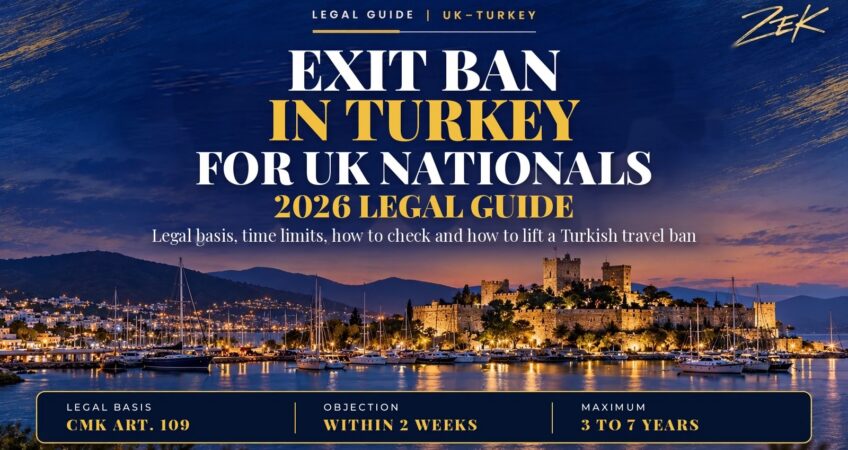
Exit Ban in Turkey: A 2026 Legal Guide for UK Nationals
İçerikler
Few things are more unsettling than being stopped at passport control in Istanbul or Dalaman and told you cannot board your flight home. For most British visitors this never happens, but every year some UK nationals discover that a Turkish court has placed an exit ban in Turkey on them, usually because they have become a suspect or defendant in a criminal case. Sometimes the ban is imposed at a hearing they attended; sometimes they only learn about it at the airport.
This guide explains, in plain English, what a Turkish exit ban (in Turkish, yurt dışına çıkış yasağı) actually is, the legal basis for it, how long it can last, how to check whether one exists, and the practical steps for challenging or lifting it. It is written for British citizens, UK residents and dual nationals, and reflects the rules as they stand in November 2026.
What Is an Exit Ban in Turkey?
An exit ban is a court order that prevents a person from leaving Turkish territory. Border police at airports, seaports and land crossings receive the details electronically, and anyone listed is refused exit until the order is lifted. The person is not in custody: they can live, work and move around inside Turkey, but they cannot cross the border.
In Turkish criminal procedure, the ban is one of the “judicial control” (adli kontrol) measures listed in Article 109 of the Code of Criminal Procedure (Law No. 5271, usually called the CMK). Judicial control is designed as a milder alternative to pre-trial detention. Instead of remanding a suspect in prison, the judge can release them subject to conditions, and “not leaving the country” is the first condition on the statutory list, at Article 109(3)(a).
Why the courts use it so often with foreign nationals
A foreign national with a home, job and family abroad is often seen as a flight risk. A judge who does not think detention is proportionate will frequently release a British suspect but impose an exit ban so that they remain available for the investigation and trial. The FCDO’s own guidance for British nationals arrested in Turkey warns that anyone granted bail may receive a travel ban and may have their passport retained by the authorities.
Only a judge can impose it
A key constitutional safeguard applies here. Since a 2010 amendment to Article 23 of the Turkish Constitution, a citizen’s freedom to leave the country may be restricted only by a judge’s decision and only because of a criminal investigation or prosecution. Before that change, tax offices could ask the police to stop people with large unpaid tax debts from leaving; the Revenue Administration stopped applying those administrative bans from 23 September 2010. The constitutional wording refers to citizens, but in practice foreign nationals also face exit bans through the same criminal-procedure route described below.
Legal Grounds for an Exit Ban in Turkey
Because the ban is a judicial control measure, the same conditions that would justify pre-trial detention must normally be present before a judge can order it. In summary:
- Strong suspicion that the person committed an offence, based on concrete evidence.
- A ground for detention under CMK Article 100, typically a risk that the person will abscond (flee) or interfere with evidence or witnesses.
- Proportionality: the measure must be proportionate to the seriousness of the allegation and the likely sentence.
Importantly, CMK Article 109(2) allows judicial control even for offences where detention itself would be prohibited. This is why relatively minor allegations, such as some traffic-related offences, assault allegations after a holiday argument, or disputes involving cheques or property deals, can still result in an exit ban.
Who decides and when
During the investigation stage, the public prosecutor asks the criminal judgeship of peace (sulh ceza hakimliği) to impose judicial control. Once an indictment has been accepted and the case is at trial, the trial court can impose, continue or lift the ban on its own initiative or on request. A court reviewing an objection to detention can also release a suspect and replace detention with an exit ban.
| Situation | Can it lead to an exit ban? | Comment |
|---|---|---|
| Criminal investigation or trial (suspect or defendant) | Yes | The main route: CMK Article 109(3)(a), ordered by a judge. |
| Unpaid Turkish tax debt on its own | No administrative ban since 2010 | Constitution now requires a judge and a criminal case; a separate tax-crime prosecution is a different matter. |
| Ordinary civil debt or enforcement file | Not by itself | Debt collection uses seizure and other civil tools, not border bans. |
| Victim or witness in a case | No | Judicial control applies to suspects and defendants, not witnesses. |
| Family dispute involving a child | Possible through separate family court measures | The FCDO notes that leaving with a dual British-Turkish child may require the Turkish parent’s permission. |
How Long Can an Exit Ban in Turkey Last?
Until 2022 there was no statutory maximum, and some people were stuck in Turkey for many years. Article 110/A of the CMK, added by Law No. 7331 and in force since 1 January 2022, now sets upper limits for the total time a person can spend under judicial control:
| Type of case | Basic maximum | Possible extension | Overall cap |
|---|---|---|---|
| Cases outside the jurisdiction of the high criminal court (less serious offences) | 2 years | Up to 1 more year, with reasons | 3 years |
| Cases within the jurisdiction of the high criminal court (serious offences) | 3 years | Up to 3 more years, with reasons | 6 years |
| Terrorism offences and certain offences against the state | 3 years | Up to 4 more years, with reasons | 7 years |
| Children (under 18) | All of the above limits apply at half the length | ||
These are ceilings, not targets. Judges can and should lift the ban earlier if the reasons for it fall away, and during the trial stage the court must review judicial control at regular intervals of no more than four months. The ban also ends automatically when the judgment becomes final, and it falls away if the prosecutor decides not to prosecute or the court acquits.
What happens if you try to leave anyway
Breaching judicial control is treated seriously. Under CMK Article 112, a suspect or defendant who deliberately fails to comply with the conditions can be arrested and remanded in custody, regardless of the likely sentence. Attempting to leave through an unofficial route can also create new criminal exposure and will badly damage your position in the original case. The only safe way out is through the court.
Stopped at the airport or worried about a Turkish case?
ZEK Legal UK works with lawyers registered with the Ankara Bar who can check the court file, explain exactly why a ban exists and file an objection quickly. Speak to us in English from the UK.
WhatsApp +44 7748 245895 Email zeki@zeklegal.co.ukHow to Check Whether You Have an Exit Ban in Turkey
Many people only discover a ban at the border. If there is any chance you are a suspect in a Turkish case, for example after a police statement, an accident, a business dispute or a complaint by a former partner, it is far better to check before you travel to the airport.
How to Challenge or Lift an Exit Ban in Turkey
There are two main legal tools: an objection against the decision imposing or continuing the ban, and a request to lift the ban, which can be made at any time while the case is ongoing. Both are governed by CMK Article 111, with objections following the general procedure in Article 268.
- Obtain the decision. Identify the court or judgeship, the file number and the date the decision was announced or served. Without this, nothing else can be done properly.
- Act within the deadline. Following Law No. 7499 of 2024, the period for lodging an objection (itiraz) is two weeks. A late objection risks being rejected on procedure alone, although a fresh request to lift can still be made later.
- Build the argument. Typical points include: no strong suspicion on the evidence, no real risk of absconding (for example a long history of cooperating, property in Turkey, a fixed address), the minor nature of the allegation, the length of time already spent under the ban, and the serious impact on your job, family or health in the UK.
- Offer alternatives. CMK Article 109 lists other measures, such as reporting to a police station at set intervals, giving a fixed address, or depositing security (a form of bail). Proposing a lighter measure often makes it easier for the judge to lift the ban itself.
- Ask for a decision on the merits. Where possible, request that your statement be taken promptly, or that the court progresses the case, so that the investigation or trial ends sooner. The ban usually ends when the case does.
- Keep evidence of hardship. Employment letters, medical reports, school records for children and proof of UK residence help show why the restriction is disproportionate.
The suspect or defendant, their spouse, their legal representative and their lawyer can all lodge an objection on the suspect’s behalf. If ordinary remedies fail and the ban has become excessively long, an individual application to the Turkish Constitutional Court, and ultimately the European Court of Human Rights, may be considered, but these are slow routes and legal advice is essential first.
What the British Embassy Can and Cannot Do
The British Embassy in Ankara, the Consulate General in Istanbul and the consulates and honorary consulates in places such as Antalya, Izmir, Bodrum, Fethiye and Marmaris can provide important support, but they cannot interfere in Turkish court proceedings.
The FCDO’s guidance page Arrested or in prison in Turkey sets this out clearly. In practice, the person who can actually change your situation is a Turkish lawyer acting on the court file.
Living in Turkey While an Exit Ban Is in Place
An exit ban in Turkey can last months or years, so practical planning matters as much as the legal challenge.
Immigration status and residence permits
British citizens can normally visit Turkey without a visa for up to 90 days in any 180-day period, according to FCDO travel advice. A ban does not automatically extend that period. If you are likely to remain longer, you should regularise your status with the Presidency of Migration Management rather than simply overstaying. Article 46 of the Law on Foreigners and International Protection (Law No. 6458) allows a humanitarian residence permit, usually for up to one year at a time, in certain cases including where it is not reasonable or possible for a foreigner to leave Turkey. Other permit types, such as a short-term residence permit, may also be available. Our guide to Turkish residence permits for UK citizens explains the main options.
Work, money and family in the UK
Tell your UK employer what has happened as early as you can; many will allow remote working if they understand it is a legal restriction rather than a choice. Check your UK bank, mortgage and tax obligations, set up powers of attorney if someone needs to manage your affairs at home, and keep your travel insurer informed, although most policies will not cover legal costs arising from criminal allegations.
Your passport
If the authorities have kept your British passport, you remain entitled to consular help, but a replacement or emergency travel document will not let you leave while the ban is in force. Keep a copy of your passport and your residence documents with you at all times.
Need someone to manage your Turkish case from London?
From our office at 284 Chase Road, London N14 6HF, ZEK Legal UK coordinates with Ankara Bar lawyers so you receive clear English updates on objections, hearings and deadlines.
Message us on WhatsApp Send an emailPractical Tips for UK Nationals Facing a Turkish Criminal Case
- Never ignore a summons or a call from the police or prosecutor. Failing to appear can itself be treated as a sign of flight risk.
- Do not sign statements you do not understand. You are entitled to an interpreter and a lawyer during questioning. Our article on being arrested in Turkey as a British citizen explains your rights in custody.
- Check before travelling. If you were involved in any incident on a previous trip, ask a lawyer to check for open files before you return to Turkey or attempt to leave.
- Keep your address up to date. Court notices are served at the address on record. Missing them because you moved can lead to decisions being made in your absence.
- Think about the whole case, not just the ban. The fastest way out of an exit ban is usually to bring the underlying investigation or trial to a conclusion.
- Read the official texts. The full text of the Code of Criminal Procedure is published on the Turkish government’s legislation portal (mevzuat.gov.tr), and the latest FCDO travel advice for Turkey is updated regularly.
Exit Ban in Turkey: Frequently Asked Questions
What is an exit ban in Turkey?
It is a court order, usually made under Article 109(3)(a) of the Turkish Code of Criminal Procedure, that stops a suspect or defendant from leaving Turkey while a criminal investigation or trial is ongoing. Border police enforce it at all exit points.
Can a British citizen be given an exit ban in Turkey?
Yes. Nationality does not protect you from judicial control. Foreign nationals are often considered a higher flight risk, so a ban is a common condition when a British suspect is released instead of being detained.
Can Turkish tax debts stop me leaving the country?
Not on their own. Since the 2010 constitutional amendment, freedom to leave can only be restricted by a judge in connection with a criminal investigation or prosecution, and administrative bans for tax debts are no longer applied. A separate criminal prosecution for a tax offence could, however, lead to judicial control.
How do I find out if I have an exit ban?
You can use the relevant query services on the e-Devlet portal if you have access, ask the police passport or border branch, or instruct a Turkish lawyer to check the court file through UYAP. A lawyer’s check is the most reliable because not every restriction appears online.
How long does a Turkish exit ban last?
It lasts until a judge lifts it or the case ends. Under CMK Article 110/A, total judicial control is capped at 3 years for less serious cases, 6 years for cases before the high criminal court and 7 years for terrorism and certain state offences, with half these limits for children.
What is the deadline to object to an exit ban?
Following the 2024 amendments made by Law No. 7499, an objection must generally be lodged within two weeks. Even after that period, you can ask the court at any time to lift the ban if circumstances have changed.
Can the British Embassy get my travel ban lifted?
No. The FCDO states that consular staff cannot have travel bans removed, transfer bail funds or intervene in court proceedings. They can provide lists of lawyers and interpreters and support your welfare.
What happens if I try to leave Turkey despite the ban?
You will be stopped at the border, and deliberately breaching judicial control can lead to arrest and pre-trial detention under CMK Article 112. It can also seriously harm your defence in the main case.
Can I stay in Turkey legally if my visa-free period runs out because of the ban?
You should apply to regularise your status rather than overstay. Article 46 of Law No. 6458 allows a humanitarian residence permit in some cases where leaving Turkey is not reasonable or possible, and other residence permits may also be available depending on your circumstances.
Does the exit ban end automatically when the case finishes?
Yes. Judicial control ends when the judgment becomes final, or when the prosecutor decides not to prosecute or the court acquits. It is still sensible to ask your lawyer to confirm that the border record has been updated before you travel.

- UK Spouse Visa from Turkey: 2026 Guide for British Citizens and Turkish Partners - Kasım 22, 2026
- Exit Ban in Turkey: A 2026 Legal Guide for UK Nationals - Kasım 21, 2026
- Selling Property in Turkey: 2026 Tax Guide for UK Owners - Kasım 20, 2026