
What Foreigners Cannot Buy in Turkey: 10% Rule & Bodrum Guide
İçerikler
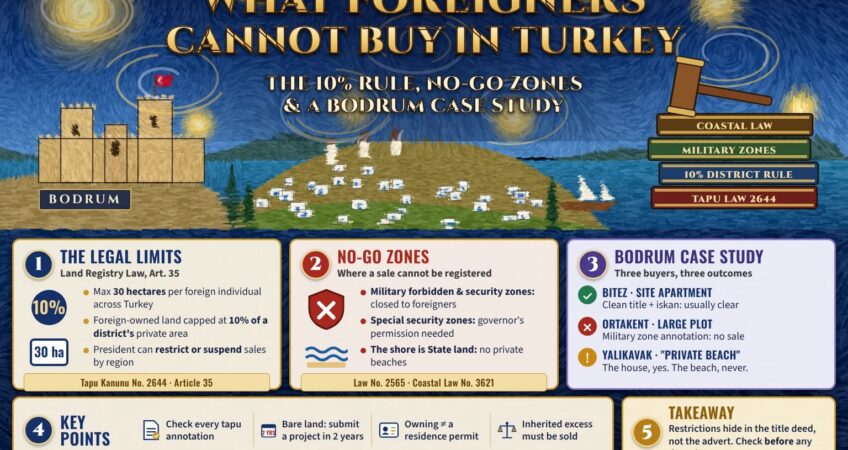
Most British buyers assume that if a seller is willing and the money is ready, a property in Turkey can be bought. In practice, Turkish law draws several lines that foreigners cannot cross, however much they are prepared to pay. This guide explains what foreigners cannot buy in Turkey, how the 30-hectare and 10% district rules work, and then applies everything to a real-world setting: buying property in Bodrum.
Key takeaways
- UK citizens can buy property in Turkey, but within limits set by Article 35 of the Turkish Land Registry Law (No. 2644).
- A foreign individual can own a maximum of 30 hectares across the whole of Turkey.
- All foreign-owned property in a district cannot exceed 10% of that district’s privately ownable area.
- Military forbidden zones and security zones are off-limits; special security zones need the governor’s permission.
- The coastline itself belongs to the State and cannot be privately owned by anyone, Turkish or foreign.
- If you buy bare land, you must submit a development project to the ministry within two years.
1. The legal basis: Article 35 of the Land Registry Law
The rules on foreign ownership sit in Article 35 of the Turkish Land Registry Law (Tapu Kanunu No. 2644), in the form amended by Law No. 6302 in 2012. That amendment removed the old reciprocity requirement, which is why British citizens today can buy without the UK having to offer Turkish citizens identical rights.
Article 35 does three things that matter to a buyer:
- It allows individuals from countries designated by the President to acquire property and limited real rights in Turkey, subject to legal restrictions. The UK is one of these countries.
- It caps how much foreigners can own, both per person and per district.
- It gives the President power to restrict, suspend or prohibit acquisitions by country, region, type or size where national interests require it.
That last power is important: the rules can change by presidential decision, without a new act of Parliament. Always check the position on the date you sign, not the date you started looking.
2. The 30-hectare and 10% district limits
The personal cap: 30 hectares
A foreign individual can own up to 30 hectares (300,000 m²) of property in total across Turkey. This includes property and independent, permanent limited real rights. The President may raise the per-person figure up to double, i.e. 60 hectares. For a typical British buyer purchasing an apartment or a villa, this cap is rarely relevant. It starts to matter with large plots, olive groves or multiple land purchases.
The district cap: 10%
The second limit is collective. The total area owned by all foreigners in one district cannot exceed 10% of the district’s area that is open to private ownership. Once a district reaches this ceiling, the land registry stops registering further sales to foreigners there, even if you have a signed contract and a willing seller.
Why this matters for popular resorts
The 10% cap is calculated per district, not per town or neighbourhood. In heavily foreign-owned resort districts, it is worth asking the land registry office (tapu müdürlüğü) early whether there are any capacity issues, before you pay a deposit.
3. No-go zones: military, security and strategic areas
Turkey’s Military Forbidden Zones and Security Zones Law (No. 2565) creates areas where foreigners’ rights are restricted:
- Military forbidden zones (askeri yasak bölge): foreigners cannot acquire or rent property here.
- Military security zones (askeri güvenlik bölgesi): likewise closed to foreign acquisition.
- Special security zones (özel güvenlik bölgesi): acquisition requires permission from the provincial governorship (valilik).
- Strategic areas designated under the same law can also be restricted.
Until a few years ago, foreign buyers in many provinces had to wait weeks for a separate military clearance letter. Today, land registry offices work from digital maps and coordinate data supplied by the Ministry of National Defence and the Ministry of Interior. In practice, the restriction often appears as an annotation in the “statements/annotations” (beyanlar/şerhler) section of the title deed. That is why a full title search is not optional.
4. Land that nobody can buy: coastline, forests and protected sites
Some land is off the market for Turkish citizens and foreigners alike. British buyers are often surprised by these rules because UK practice is so different.
- The coastline (kıyı): under the Coastal Law (No. 3621), the shore is under the control of the State and is open to everyone. It cannot be privately owned, and the strip immediately behind it is subject to strict building restrictions. A “private beach” in a sales brochure is usually, legally speaking, a public shore that the property happens to face.
- State forest land: forests cannot be cleared for fields or private buildings except where special laws allow. Plots that border or overlap forest boundaries carry real risk.
- Protected sites (sit alanları): archaeological, natural and urban conservation areas restrict what can be built, altered or extended. The land can be owned, but your plans for it may not be possible.
- Treasury land: land registered to the State can only be acquired through official tender processes, which come with their own conditions.
5. Buying bare land: the two-year project rule
If you buy a plot with no building on it (yapısız taşınmaz), Article 35 requires you to submit the project you intend to develop to the relevant ministry within two years. Once approved, the project and its start and completion dates are recorded on the title deed. The ministry then monitors whether you actually build it.
If you miss the two-year deadline, use the land contrary to its purpose, or fail to complete the project on time, the Treasury can order you to sell (liquidate) it. If you do not sell within the period given, which cannot exceed one year, the State sells it and pays you the proceeds. Buying a plot “to sit on” as a long-term investment therefore needs careful planning.
6. Ownership is not residence: closed neighbourhoods
A separate set of rules, run by the Presidency of Migration Management, limits new residence permit registrations in neighbourhoods where the foreign population has reached a set ratio. These are commonly called “closed neighbourhoods” (kapalı mahalleler).
Two points are often confused:
- A closed neighbourhood does not stop you from buying. The land registry can still transfer the title.
- It can stop you from registering that address for a residence permit. If you plan to live in Turkey on a property-based permit, check the neighbourhood’s status before you commit.
The list changes over time, so rely on a current check rather than an agent’s assurance.
7. What happens if you inherit beyond the limits
Inheritance is one of the few ways a foreigner can end up holding property they could not have bought. Article 35 deals with this directly: property inherited outside the limits in the first paragraph (for example, in a military zone or above the 30-hectare cap) must be sold within a period set by the Treasury, not exceeding one year. If the heir does not sell, the State liquidates it and pays the heir the proceeds. If you are a British heir to Turkish land, check the title before you assume you can keep it.
8. Practical case study: buying in Bodrum
Bodrum is one of the most popular destinations for British buyers in Turkey. The UK has for years been the town’s leading foreign tourist market, and many visitors return as owners. It is also a place where almost every restriction above can apply within a few kilometres. The three scenarios below are illustrative examples built on real legal rules; they are not descriptions of specific listings.
Scenario A: An apartment in an established site in Bitez
The buyer: Sarah, from Manchester, wants a two-bedroom flat in a gated site (complex) in Bitez for holidays and later retirement.
What to check:
- Title type: ideally a condominium title (kat mülkiyeti) with a habitation certificate (iskan). This confirms the building was completed and approved.
- Annotations: the “beyanlar/şerhler” section should show no military, security, mortgage or seizure annotations.
- District capacity: confirm with the Bodrum land registry office that sales to foreigners are being registered normally.
- Residence plans: because Sarah wants to retire there, she should confirm the neighbourhood is open for residence registration.
Outcome: with a clean title and an iskan, this is the type of purchase where foreign-ownership restrictions rarely cause problems. The risks here lie elsewhere, in price, site fees and contract terms.
Scenario B: A large plot near Ortakent
The buyer: David and James want to buy a large plot with sea views between Ortakent and Turgutreis and build two villas.
What to check:
- Military annotations: parts of the Bodrum peninsula carry military zone records. For example, when large Treasury parcels in Ortakent were put out to tender in 2022, the tender terms warned that the title deeds were annotated as lying within a military forbidden and security zone, and told bidders to check their eligibility before bidding.
- Bare land rule: the plot has no building, so a development project must go to the ministry within two years.
- Zoning (imar): agricultural or olive-grove status can severely limit what can be built.
- Size: large plots move closer to the 30-hectare personal cap, especially if the buyer already owns land elsewhere in Turkey.
Outcome: if the title carries a military forbidden or security zone annotation, a sale to foreign individuals cannot be registered. Even without it, a land purchase brings a two-year project obligation. This buyer needs a full title and zoning review before any deposit is paid.
Scenario C: A “seafront” house in Yalıkavak
The buyer: Emma is offered a renovated stone house advertised as having “its own beach and jetty”.
What to check:
- Coastal edge line (kıyı kenar çizgisi): the beach in front cannot be private property. Any structure on the shore or in the strip behind it may be unlicensed and at risk of demolition.
- Jetty: a jetty on the public shore requires its own permits. If it was built without them, it adds risk rather than value.
- Protected site status: much of the Bodrum peninsula falls within natural or archaeological protected areas. This can block extensions, pools and renovations.
- Licence of existing works: compare the current building to the approved project. Unauthorised extensions are common in older coastal houses.
Outcome: foreigners may be able to own the house itself, but not the beach. The value the agent is selling, the “private” waterfront, may be legally unprotected.
Bodrum at a glance: which rule hits where
| Property type in Bodrum | Main legal risk | What to obtain |
|---|---|---|
| Apartment in a completed site | Missing iskan, unpaid debts, residence registration | Title record, iskan, site debt statement |
| Villa on its own plot | Unlicensed extensions, protected site rules | Approved project, municipal zoning letter |
| Bare land / olive grove | Military annotations, two-year project rule, zoning | Full title annotations, zoning status |
| Seafront property | Coastal Law, unlicensed shore structures | Coastal edge line plan, building permits |
| Off-plan unit | Developer delays, land ownership of the developer | Developer’s title, building permit, contract review |
9. Pre-purchase checklist for UK buyers
- Get the full title record from the land registry, including every annotation, not just the owner’s name.
- Look up the parcel on the official TKGM parcel query service to confirm its location and boundaries.
- Ask the land registry office whether there is any obstacle to registering a sale to a British citizen in that district.
- Check zoning with the municipality: what can be built, and whether the land is in a protected site.
- For seafront property, check the coastal edge line and the licence status of any shore structures.
- For bare land, plan your project timeline around the two-year submission deadline.
- If you will live there, confirm the neighbourhood is open for residence registration.
- Pay no deposit until the checks above are done, and tie any deposit in the contract to a clean title transfer.
The simple rule
The restrictions on foreign ownership are rarely visible in an advert. They show up on the title deed, in the zoning file and at the land registry desk. Do the checks before you pay, not at the tapu office on transfer day.
10. Frequently asked questions
Can British citizens buy property anywhere in Turkey?
No. British citizens can buy in most of Turkey, but not in military forbidden or security zones, and not where the district has reached the 10% foreign-ownership limit. Special security zones require the governor’s permission.
What is the 10% rule for foreigners buying property in Turkey?
All property owned by foreign individuals in a district cannot exceed 10% of that district’s area that is open to private ownership. When a district reaches the cap, further sales to foreigners there cannot be registered.
How much land can a foreigner own in Turkey?
Up to 30 hectares per person across the whole country. The President has the power to increase this up to 60 hectares.
Do I still need military clearance to buy in Bodrum?
A separate clearance letter is no longer the routine step it once was in Muğla. Instead, the land registry checks the parcel against official zone maps, and restrictions usually appear as annotations on the title. A parcel inside a military forbidden or security zone still cannot be sold to a foreign individual.
Can I own a private beach in Bodrum?
No. Under the Coastal Law, the shore belongs to the State and is open to everyone. A house can face the sea, but the beach in front of it cannot be privately owned.
Can I buy land in Turkey and leave it undeveloped?
Not indefinitely. A foreigner buying land without a building must submit a development project to the relevant ministry within two years. Failing to do so can lead to a forced sale.
If a neighbourhood is closed to foreigners, can I still buy there?
Yes. “Closed neighbourhood” rules restrict new residence permit registrations, not property purchases. You can buy, but you may not be able to use that address for a residence permit.
Buying in Bodrum or elsewhere in Turkey?
ZEK Legal UK supports British buyers with title and annotation reviews, zoning checks and contract review, working with lawyers registered at the Ankara Bar. Contact us before you pay a deposit: zeki@zeklegal.co.uk · +44 7748 245895 (WhatsApp)
This article is general information based on Turkish Land Registry Law No. 2644 (Article 35), Military Forbidden Zones and Security Zones Law No. 2565 and Coastal Law No. 3621, as at October 2026. It is not legal advice for any specific property. Rules can change by presidential decision, so verify the current position before any transaction.
